Pastry Passport Week 10: Nigerian Puff-Puff with 'Pemi Aguda 🇳🇬
Hi!
I had the inkling that I’d be spending this newsletter — the final edition in our 10-week Pastry Passport program — talking about how much I loved doing this, what I learned, what bonds were formed, what ingredients I’ll forever use (piloncillo sugar is now a staple in my household for tamarind agua fresca — thank you, Teresa). But then I realized that would take away from our grand finale — Nigerian puff-puff — one of the tastiest, most exceptional fried things I’ve ever eaten. Let’s focus on that instead.
We’ll be selling six-packs of puff-puff at the bakery, still warm from the fryer if you get there early, for $5. We’ll have extras for non-Passport holders, as well.

So what is puff-puff? It’s a fried yeasted dough with a hint of nutmeg in the batter, which can be covered in sugar or plain, or dressed up in a thousand different ways. For ours, we’ve decided to follow writer and cook Yewande Komolafe’s take, which includes allspice and cloves in the sugar, too. The lightness and sweetness makes for the kind of donut that you inevitably go, “Ah I’ll just have another,” until there are simply no more to eat. They’re divine.
Since this is the grand finale of Pastry Passport, we had to go out with a bang. So when I was thinking about who I wanted to talk to about puff-puff, I went a little farther afield and got Nigerian novelist and fiction writer ‘Pemi Aguda on the line to talk with us. This was a dream, as her books Ghostroots and One Leg on Earth are two new favorites for me. She’s also Philly-based, which we love. It was a great conversation and I cannot recommend highly enough that you get both of her books. Read on below as ‘Pemi schools me on the best donut you’ll ever eat.
Buy and Read ‘Pemi’s Books!Downtime Bakery: Tell me a bit about yourself and your background.
‘Pemi Aguda: My name is ‘Pemi Aguda and I’m from Lagos, Nigeria. I write fiction. My first book was a story collection titled Ghostroots, and my second is a novel, One Leg on Earth. I’m on the MFA faculty at Bennington College, and I am the Hortense Spillers assistant editor at Transition Magazine.
DTB: Tell me about puff-puff. What are the defining features of good puff-puff? Where do you typically find them in Nigeria? Do they come in savory and sweet preparations?
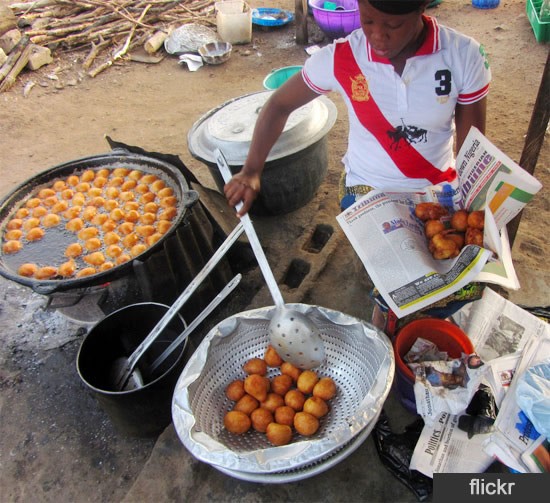
PA: Puff-puff is basically deep-fried dough. There are all kinds of recipes, but mostly, these soft fluffy balls of (flour + yeast + sugar) deliciousness tend to be sweet, although some recipes add a sprinkle of ground chilli pepper for some bite. Up until recently, you could find a woman frying puff-puff by the roadside in a giant frying pan. Or men hawking them in small show-glasses balanced on their heads. I always preferred the former, loved to see these women squeeze the dough out the side of a fist, then watch the balls turn golden in the heat. Oh, the way the balls bobbed and shimmied in the oil, slotted spoons dipping in to give all sides the same attention. The sellers then wrapped your order in old newspaper before sliding it into a plastic bag. I always received the warm parcel with joy.
Puff-puff is a star member of small chops — Nigerian finger foods — served at events and celebrations. (A plate of small chops could have puff-puff, masa, samosas, spring rolls, and peppered gizzard/chicken.) The best puff-puff is golden-brown on the outside, airy on the inside. Not too greasy. If it is dense and crunchy, then you have made what Nigerians call ‘buns.’ Puff-puff is best served hot.
DTB: Do you have standout memories of eating puff-puff in Nigeria? How and when are you eating them most? Is puff-puff a food home cooks are making as well or is it mostly a market food?
PA: When I was a younger teenager, my mother had a shop. During holidays, my sisters and I sometimes helped out. The one thing that made these everlastingly long and boring days worth it was knowing that I could buy puff-puff from a woman in the market. Her puff-puff balls were always so even in colour and shape. They were cheap, so, I didn’t have to ask for money. I would have greedily eaten half my treasure on my way back to the shop. Later, when I was home on university breaks, my mother knew to buy puff-puff on her way back home. And even later, when I started driving to work, my friend and I would park, then queue with other Lagosians (every demographic was present in these lines) to buy puff-puff to eat in the notorious traffic.
Puff-puff tends to be sold as street food, or served at parties. It was rarely restaurant food — it’s such an oily process, people tend to make large batches, and since it’s best served immediately, I can’t imagine it’s agreeable to restaurants. That’s my theory, anyway. (My sister, who is in Lagos, tells me that there are pastry shops that have puff-puff on the menu now.) Same for the home; I’ve only ever made puff-puff when hosting, again because bigger quantities justify the process.
DTB: The recipe I used from Yewande has nutmeg in the batter, and nutmeg, clove, and allspice in the sugar mix. Are there versions of puff-puff that contain different spices? I've seen it most often with nutmeg only.
PA: Asides from the chilli version, I’ve known people to also throw in some ginger, but mostly, nutmeg is what is used. These days, there are versions of puff-puff with metaphoric bow ties: slathered in chocolate, stuffed with jammy fillings, sprinkled with powdered sugar. Every puff-puff is a blessing, but my favourite is the simplest.
DTB: When you're writing, how much does the food of Nigeria come into your stories and novels? Why did you choose to highlight the market and the food of the market as such an integral part of your story "Girlie"?
PA: Oh, I love food, and I love Nigerian food. For me, I can’t represent the culture and setting without talking about the food. I can’t separate the sensorial details of Lagos from what the people are eating. It’s an overstimulating city, and a good percentage of that can be ascribed to food smells. I find Nigerian markets to be exciting worlds—so much to witness, every corner brimming with a different weirdness, a space that features every kind of Nigerian, the inventive choreography of bargaining: walking away, hoping to be called back by the seller.
Perhaps my little anecdote about my time in the market as a teenager is some context for “Girlie,” although my mother’s market was a buttoned up version of the one rendered in the story. I liked thinking about how Girlie’s understanding of market mathematics would differ from her employers, and the ways she might find delight and pain moving through it as a child with adult responsibilities. Even as an adult, a Nigerian market demands that I enter it as a child again. Do I sound confident? Will I get lost? What will I discover?
DTB: Is there anything about Nigerian cuisine that you wish people understood that you don't think they understand now? What makes Nigerian cuisine special to you?
PA: Great questions. Perhaps that Nigerian cuisine is far more varied than what’s represented internationally. The Nigerian restaurants I encounter in the U.S. and UK seem to be focused on the food of the west, sometimes, the east and south-south … but there’s so much more, with a country with over 250 ethnic groups. Diverse ingredients and techniques. There’s so much more to discover, even for me! I love how improvisational Nigerian cooking is. Sure, there are recipes, but everyone seems to tap into some intuitive calibration. A lot of our food is decadent, too, in heat and oils, and I think it’s indicative of a people who know how to enjoy their lives.
DTB: Is there anything you'd like to plug or highlight for the newsletter?
PA: Always the books! There’s so much around food in Ghostroots, and I’d like to point out a story titled “The Dusk Market” that’s set in a strange Nigerian market. And in One Leg on Earth, there’s food everywhere. Also, Ozoz Sokoh's Chop Chop, which has a range of Nigerian recipes, I highly recommend.

Add a comment: